
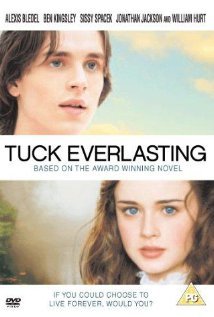
TUCK EVERLASTING
Beautifully acted, spiritually mixed, and best for discerning teens and adults.
Should You Watch It?
Tuck Everlasting is a beautiful, thoughtful fantasy with excellent acting and impeccable direction. Its central questions are substantial: What makes life worth living? Is immortality truly desirable? How should we face death, discover purpose, and understand the stages of life?
The film also misses an important opportunity. Its story could have developed stronger moral and redemptive connections to biblical themes, but instead relies on pagan metaphors such as the Wheel of Time and the Circle of Life. Its morally ambiguous resolution may leave Christian viewers unsatisfied.
Still, the film affirms family life, purpose, mortality, reconciliation, and the importance of living fully. Teenagers and adults who can discuss its worldview thoughtfully may find much to consider. You can take the trip if your family is ready to practice discernment.
The Story
NO SPOILERS — WE KEEP THE SURPRISESIn 1914, seventeen-year-old Winnie Foster longs to escape the tight structure of her wealthy family. Lost in the woods, she meets Jesse Tuck and his mysterious family, who live near a spring granting immortality to anyone who drinks from it.
When Jesse’s older brother, Miles, takes Winnie to protect the family secret, a greedy man in a yellow suit begins closing in. The town’s search for Winnie puts the Tucks’ hidden life at risk.
Is It Any Good?
Three stars means this is a good film with meaningful strengths, though it falls short of its full artistic and spiritual potential.
Alexis Bledel and Jonathan Jackson give believable performances as Winnie and Jesse. The distinguished supporting cast includes Sissy Spacek, William Hurt, Ben Kingsley, and Amy Irving, creating an excellent ensemble. Director Jay Russell also does a fine job adapting the story for the screen.
The limitation is not principally technical. The film’s moral and redemptive ideas remain underdeveloped, and its pagan worldview weakens what could have been a more satisfying conclusion.
The Worldview
Tuck Everlasting explores immortality, greed, good and evil, nature, the stages of life, and personal destiny. Its strongest moral insight is that endless life is not necessarily a good life. Jesse’s father, Angus, explains that immortality has isolated the family from humanity and tells Winnie, “Don’t be afraid of death. Be afraid of the unlived life.” He urges her to live purposefully despite mortality.
The film also validates traditional family life. Winnie finds purpose as a beloved wife and mother, receives important lessons from Angus and Mae, and experiences reconciliation with her own mother. A Christian funeral mentions “Lord Jesus Christ” and the Resurrection.
However, the movie relies on pagan metaphors such as the Wheel of Time and the Circle of Life, along with an environmentalist message about protecting sacred nature. It also includes a morally relativistic resolution in which someone escapes proper justice. The film could have connected its magical spring more clearly to biblical themes such as the Tree of Life and the Tree of the Knowledge of Good and Evil, but it does not.
The film rightly recognizes that a meaningful life matters more than avoiding death. Scripture similarly teaches us to number our days: “So teach us to number our days that we may get a heart of wisdom” (Psalm 90:12).
The Content Guide
The specifics — spoilers included by nature — so you can judge for your own family.
Content Summary
Dominant pagan worldview with environmentalist elements, mitigated by some moral elements and Christian funeral that mentions “Lord Jesus Christ” and the Resurrection; two light obscenities and one light profanity; villain holds gun on defenseless woman, excessive force done in self-defense kills one man and two people shot in chest but don’t die; no sex but teenage couple uses underwear as swimsuits and they cuddle at least twice; upper male nudity and woman in old-fashioned underwear; no alcohol use; no smoking; and, kidnapping, greed, violent threats, and moral relativism used to escape villain and break people out of jail.
Talk About It
Questions for the drive home, the dinner table, or the youth group.
Angus tells Winnie not to fear death but to fear an unlived life. What gives a life purpose, and how can you live purposefully now?
Psalm 90:12 · Ephesians 2:10The Tucks experience isolation because of immortality. How do relationships and family help make life meaningful?
Genesis 2:18 · Romans 12:10The film uses the Circle of Life and the Wheel of Time. How does Scripture’s view of creation and time differ from these ideas?
Genesis 1:1 · Acts 17:24–25Winnie experiences reconciliation with her mother. What does biblical reconciliation require, and where might your family practice it?
Matthew 5:23–24 · Colossians 3:13The Final Word
Tuck Everlasting is well acted, beautifully directed, and rich with questions about mortality, purpose, and family. Its pagan worldview and morally ambiguous resolution call for discernment, but thoughtful teenagers and adults may find the journey worthwhile. WORTH THE TRIP — MIDDLE SCHOOL AND UP.









