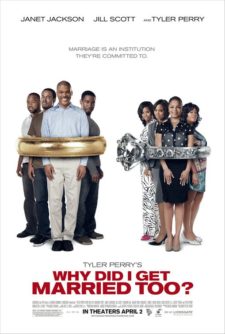
TYLER PERRY’S WHY DID I GET MARRIED TOO?
An intense marriage drama best saved for discerning adults at home.
Should You Watch It?
This sequel takes four middle-class African American couples to an annual marriage retreat in the Bahamas, then follows their marital problems back to Atlanta. The drama has a serious subject: love and commitment matter when marriages are under pressure.
But the film is too shrill and uninspiring to generate much sympathy for its characters. Its meandering story and seemingly endless arguments delay its lesson until the very end. The marital violence between Patricia and Gavin is disturbing, and the movie contains more strong foul language than its predecessor, along with alcohol use.
The film also lacks the strong positive references to Christianity or Jesus Christ found in some of Tyler Perry’s other movies. Because of the content and the weak execution, wait for home—and reserve it for discerning adults.
The Story
NO SPOILERS — WE KEEP THE SURPRISESFour couples—Terry and Diane, Patricia and Gavin, Troy and Sheila, and Angela and Marcus—meet in the Bahamas for their annual marriage retreat. Their week is disrupted by Sheila’s abusive ex-husband, while tensions inside the marriages rise.
After the couples return to Atlanta, joblessness, suspicion, bickering, and unresolved relationship problems put further pressure on them. Each marriage must face what has been hidden beneath the arguments.
Is It Any Good?
Two stars means the film has a serious premise but does not make its drama compelling enough. Its central lesson—that love is the ultimate glue holding a marriage together—arrives too late to overcome the meandering story.
The arguments often become shrill and seem to continue endlessly. The characters’ marital problems therefore generate little sympathy, and the sequel is not as interesting or worthwhile as the previous Why Did I Get Married.
The Worldview
The film gives marriage and love a central place, but its worldview is mostly a-religious and humanistic. There are a couple of light statements of gratitude to God, yet the story contains no strong positive references to Christianity or Jesus Christ.
Patricia, the marriage counselor, appears to rely on humanist, “feely touchy” psychobabble rather than a clearly biblical understanding of marriage. The film’s frequent bickering, intense arguments, insults, and divorce reflect a troubled view of relationships, even as the final lesson affirms love as essential.
The film’s central longing is for love to hold a marriage together through suffering. Scripture calls husbands to a love shaped by Christ: “Husbands, love your wives, as Christ loved the church” (Ephesians 5:25).
The Content Guide
The specifics — spoilers included by nature — so you can judge for your own family.
Content Summary
Light moral worldview with a couple light statements of gratitude to God but with a lot of bickering reflecting a strong a-religious pagan perspective and some humanist psychobabble; at least 67 obscenities (including many “h,” “d,” and a** words) and five light profanities (My God or Oh God); strong, sometimes disturbing, marital violence includes drunken man struggles with wife holding her down forcibly on couch, drunken man slams vodka bottle down onto floor, distraught woman smashes glass objects in living room, car crash after argument, angry woman fires gun in house, and man punches another man; discussion about possible affairs, couple discusses woman’s emotional obsession with another man, sounds of fornication heard, married men briefly discuss marital sex, and woman finds unmarried maid and gardener in her bed; frequent upper male nudity and some female cleavage; alcohol use and drunkenness; brief smoking; and, married couple constantly bickers, intense arguments, insults, and divorce.
Talk About It
Questions for the drive home, the dinner table, or the youth group.
The couples’ arguments reveal how unresolved problems can damage a marriage. What does Scripture teach about being “quick to hear, slow to speak, slow to anger”?
James 1:19–20The film presents love as essential to holding a marriage together. How does Christ’s sacrificial love give that idea a deeper meaning?
Ephesians 5:25 · 1 Corinthians 13:4–7The story includes suspicion about possible affairs and emotional attachment to someone outside a marriage. Why does Scripture call believers to flee sexual immorality and pursue faithfulness?
1 Corinthians 6:18 · Hebrews 13:4The film’s counseling perspective is largely humanistic. Where can people seek wisdom when their relationships are under pressure?
James 1:5 · Proverbs 15:22The Final Word
This intense sequel takes marriage seriously but buries its message beneath shrill arguments, disturbing violence, foul language, and a largely a-religious worldview. Watch only at home, and only if you are a discerning adult prepared for its content. WAIT FOR HOME — ADULTS ONLY. For more suitable choices, see.