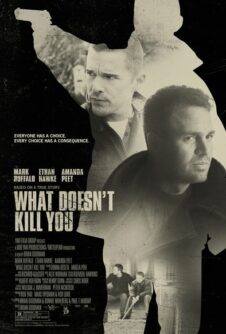
WHAT DOESN’T KILL YOU
A well-acted story of redemption, wrapped in a hard R.
Should You Watch It?
Here's the short version: this is a crime drama that actually believes crime doesn't pay, carried by two strong performances, and it earns its R rating at nearly every turn.
Mark Ruffalo and Ethan Hawke play childhood friends from the streets of Boston who steal and shake down businesses for local crime lords. Ruffalo's Brian sinks into crack addiction; his crimes cost his marriage and his children dearly. Prison and Alcoholics Anonymous eventually force him to face what he's become, and — unlike his friend Paulie — he chooses a better road.
That choice is the film's heart, and it's a real one, including a scene where the Lord's Prayer is recited at an AA meeting. But getting there means sitting through much foul language, real violence, drug use, and a depicted sex scene between the married couple. This is a story worth watching for the right viewer — an adult who can handle hard content for the sake of a genuine redemption arc — but it was never made for family movie night.
The Story
NO SPOILERS — WE KEEP THE SURPRISESBrian and Paulie are childhood friends from the streets of Boston who grew up learning crime early. As adults, they steal and shake down small businesses for local crime bosses, while Brian's addiction and choices take a toll on his wife and children. When a heist goes wrong, both men land in prison — and Brian is forced, for the first time, to confront the life he's living.
Is It Any Good?
Three stars means this: a genuinely well-made drama with a slow start and a strong finish. Mark Ruffalo and Ethan Hawke carry the film with excellent performances as the two thieves, and Amanda Peet brings real heart to her role as Brian's strong, longsuffering wife. The story takes time to build momentum — it doesn't fully engage until Brian is wounded partway through — but an unexpected twist near the end lands as a genuine, satisfying surprise. The craft here is solid enough to make the film's hard content worth wrestling with rather than dismissing outright.
The Worldview
This film gets its central conviction right: crime doesn't pay, and redemption is possible. Most of the runtime shows Brian and Paulie trying to make crime pay anyway — through threats, theft, and extortion — but the film never pretends this path leads anywhere good. It leads to prison, addiction, and a wrecked family.
The clearest sign of the film's moral seriousness comes in its AA scenes. At one meeting, the Lord's Prayer is recited aloud. Brian admits the part about praying makes him uncomfortable and leaves; his sponsor tells him it once made him uncomfortable too. It's a small moment, but it treats prayer and honest struggle with more respect than most crime dramas bother to.
None of this erases the cost of getting there. The film depicts real drug use, real violence, and a married couple's sexual relations onscreen — content that keeps this from being a film for younger viewers even as its message aims true. Brian's arc is, in the end, a story about choosing your family over your appetites, one day at a time — which is a longing Scripture speaks to directly: "the one who did not spare his own Son... how will he not also with him graciously give us all things," and repentance is always met with grace (Romans 8:32; see also Luke 15:20).
The Content Guide
The specifics — spoilers included by nature — so you can judge for your own family.
Content Summary
Strong moral worldview of crime not paying and the hope of redemption, with a reference to the Lord’s Prayer; 104 obscenities, one profanity; strong crime violence of two characters being shot, multiple characters beat up in fist fights; depicted scene of sexual relations between married couple; upper male nudity, couple in bed together but covered up; much drinking of alcohol; much smoking and much use of illegal drugs; and, stealing, extortion, lying.
Talk About It
Questions for the drive home, the dinner table, or the youth group.
Brian's turning point comes when he sees his children growing up without him. What does it cost a family when a parent chooses a life of crime, and what does it look like to turn back?
Luke 15:11–24The Lord's Prayer is recited at an AA meeting, and Brian admits it makes him uncomfortable. Why might honest prayer feel uncomfortable to someone facing their own failures — and what changes that?
Psalm 51:1–4Paulie chooses a different path than Brian. What does the film suggest determines whether someone breaks free from a destructive life or stays in it?
Proverbs 14:12 · Galatians 6:7–8The film insists crime doesn't pay, even while showing characters chasing it for most of the story. Where else do we see people convinced that shortcuts will work, despite all evidence otherwise?
Ecclesiastes 5:10The Final Word
This is a hard, honest film about a man choosing his family over the life that nearly destroyed him — well acted, well built, and unflinching about what that choice costs. It's also graphic enough that it's not a film to watch lightly or with kids in the room. Our verdict stands: worth the trip — adults only. Looking for something to watch as a family instead? Start with our latest family-friendly picks.