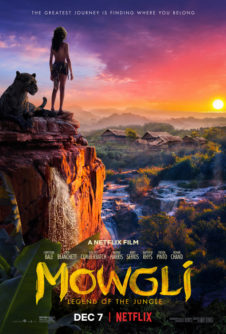
MOWGLI: LEGEND OF THE JUNGLE
Dark, unnecessary remake, too violent for children.
Should You Watch It?
This is a well-crafted but unnecessary remake. Andy Serkis’s darker version has remarkable animation and visual effects, and Rohan Chand gives a memorable performance as Mowgli. The film also offers light themes about acceptance, belonging, community, and being unique.
But the darker style does not sustain the movie. The story feels too familiar, drags at times, and plays better to children than adults. Yet the violence, blood, frightening animals, injuries, and disturbing hunting imagery make it unsuitable for younger viewers. The worldview also includes pagan beliefs, mysticism about souls, and references to Hindu beliefs about sacred cows.
The result falls between audiences: too violent for younger children and not engaging enough for adults. For your family, skip it.
The Story
NO SPOILERS — WE KEEP THE SURPRISESMowgli is a human boy found and raised by a pack of wolves. As he grows up in the jungle, he is hunted by the tiger Shere Kahn and struggles with the differences that set him apart from the pack.
When Mowgli faces a rite of passage and must leave the jungle for a human village, he is torn between his wolf family and the human world. Meanwhile, Shere Kahn begins taking over the jungle.
Is It Any Good?
Three stars means this film has real craft but does not overcome its weaknesses. Directed by motion-capture legend Andy Serkis, it features remarkable animation work and visual effects. Rohan Chand gives a memorable performance, especially because he is the only live-action character during much of the movie’s first part.
The darker tone brings more intense action and higher stakes, but that novelty wears off. The story remains familiar, predictable, and occasionally padded with set pieces that feel like filler. Its dramatic approach sometimes borders on melodrama, especially near the end.
The Worldview
The movie includes light themes of acceptance, belonging, community, and uniqueness. Mowgli is an outsider who must learn where he belongs, and the film speaks against bullying through messages that differences should not be mistaken for weakness.
The film also presents a mixed pagan worldview. It includes mysticism involving souls departing bodies after death, and Kaa prophesies that Mowgli will become a special leader of both the jungle and humanity. The animals are sympathetic to Hindu beliefs that cows are sacred. Strong environmentalist themes portray humans as destroying the sacred jungle, taking animals captive, and hunting them for sport.
The movie’s moral themes are weaker than those in previous versions. Its central longing for belonging is real, but the film does not connect that longing to a biblical understanding of identity and community. Scripture says, “you are no longer strangers and aliens, but you are fellow citizens with the saints and members of the household of God” (Ephesians 2:19).
The Content Guide
The specifics — spoilers included by nature — so you can judge for your own family.
Dominant Worldview and Other Worldview Content/Elements
Mixed pagan worldview includes pagan beliefs and some mysticism involving souls departing bodies after they die, with strong environmentalist themes about humans destroying the sacred jungle, taking animals captive, and hunting them for sport, with some references to Hindu beliefs that cows are sacred and light moral elements about community, belonging, and acceptance.
Foul Language
One light profane instance of “God knows I’m not”
Violence
Strong violence includes a baby is found with blood on it, a group of wolves push around and bully another wolf, wolf pack stumbles on a decaying and bloody cow carcass, a tiger gets blood in the water when it drinks from a lake, tiger villain makes several references to “tasting blood” or wanting to taste blood, several action sequences involving wolves trying to outrun a panther as a rite of passage that involves aggressive running and pushing and shoving and biting, monkey people kidnap Mowgli, drag him through the jungle and knock him unconscious with a large rock, a tiger scratches boy hero and gives him large and bloody gashes on his arm for the remainder of the movie, a bear and a panther get into a fight with the monkey people and leave leaving scratched and bloody fur, boy makes threats to tiger villain about setting him ablaze and watching him burn alive, children throw rocks at boy, hunter teaches Mowgli how to throw knives, an intense fight with a tiger involves clawing and growling and stabbing, hunter shoots at a tiger and hits a human instead, human becomes the victim of an elephant stampede, and various wolves die of their injuries from fighting other animals
Sex
No sex
Nudity
Upper male nudity when boys wear pants with no shirts and boy takes a bath
Alcohol Use
Man drinks by the fire and remains drunk for multiple scenes following
Smoking and/or Drug Use and Abuse
Man smokes a pipe;
Miscellaneous Immorality
Scary elements and images such as a giant slithering snake, plus monkey people kidnap boy.
Talk About It
Questions for the drive home, the dinner table, or the youth group.
Mowgli struggles with where he belongs. What does the Bible say about finding our deepest identity and belonging?
Ephesians 2:19 · 1 Peter 2:9The film includes messages about acceptance and uniqueness. How can your family treat people who seem different from you?
Romans 15:7 · James 2:1–4The movie presents the jungle as sacred and humans as destroyers. How should Christians care for creation while remembering that God alone is worthy of worship?
Genesis 1:27–31 · Romans 1:25The film includes beliefs about souls departing bodies after death. What hope does Scripture give Christians about death and resurrection?
John 11:25–26 · 1 Corinthians 15:20–22The Final Word
MOWGLI: LEGEND OF THE JUNGLE has striking visuals and a memorable central performance, but its familiar story, harsh content, and weakened moral themes leave it stranded between audiences. For your family, SKIP IT. Consider these instead.