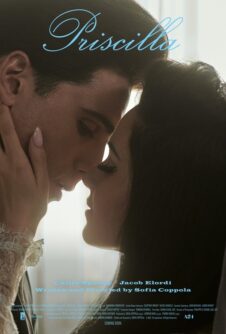
PRISCILLA
A beautifully acted portrait of a gilded cage — for grown-ups.
Should You Watch It?
Here is the decision in full. Sofia Coppola has made a beautiful, quiet, well-acted character study — an impressionistic portrait of Priscilla Presley from the night she met Elvis in 1959 to the day she signed her divorce papers in 1973. It is realistic, thoughtful, and genuinely moving as a coming-of-age story about a young woman finding her way out of a stifling bubble.
But it earns its R. There's strong profanity, scenes of pill and LSD abuse, heavy kissing in the bedroom before marriage, and — at the story's center — an adult man beginning to court a 14-year-old girl. The film views all of this through a Romantic, feminist lens that shapes what it shows and what it leaves out.
So: if you're an adult who can watch a slow, well-crafted drama and weigh its troubling subject with discernment, this is one to consider — at home, where you set the terms. If you're choosing for children or teens, choose something else.
The Story
NO SPOILERS — WE KEEP THE SURPRISESGermany, 1959. At a party thrown by a soldier named Elvis Presley, a shy 14-year-old named Priscilla catches the eye of the 24-year-old rock icon. He asks her stepfather's permission to court her, and a romance begins that will define the rest of her young life.
When Elvis leaves the Army and returns to America, Priscilla assumes it's over. It isn't. An invitation to Graceland pulls her deeper into his glittering, isolating world — and into the question at the heart of the film: what does it cost to live inside someone else's dream?
Is It Any Good?
Three stars, and here is what they mean. This is a well-acted, well-produced film, and Coppola's impressionistic approach gives it a delicate, dreamlike texture. Cailee Spaeny and Jacob Elordi carry a story that lives almost entirely in mood, glances, and the slow erosion of a young woman's independence.
The trade-off is pacing. Because the movie concentrates so heavily on character rather than plot, it plays slowly — deliberately so, but slowly all the same. This is a portrait, not a page-turner. Viewers who come for Elvis-the-legend will find instead a study of the woman beside him and the claustrophobic world he built around her. On its own terms, it succeeds; whether those terms hold your attention is another matter.
The Worldview
PRISCILLA is told entirely through Priscilla's eyes, and it carries a Romantic worldview with a strong feminist subtext. The film frames her story as a woman discovering her "identity" as an independent person — bursting the bubble that Elvis built around her at Graceland. There are gentle grace notes too: Elvis briefly sings a gospel song, and there are light references to Christmas.
That lens shapes what the movie shows and what it withholds. It presents her relationship with Elvis — begun when she was 14 — through a romantic haze, and it lightly acknowledges Elvis's affairs while quietly omitting Priscilla's own. What the film does portray honestly is the cost of control: Elvis dictating her clothes, her hair, and where she could go, until the marriage collapses. The picture's sympathy is real, but its moral frame is Priscilla's, not Scripture's.
Underneath the story runs a longing the film can name but not satisfy: the desire to be truly known, truly free, and truly loved. Priscilla seeks that freedom by walking out the door. Scripture points somewhere deeper — freedom not as escape but as the fruit of truth: "So if the Son sets you free, you will be free indeed" (John 8:36).
The Content Guide
The specifics — spoilers included by nature — so you can judge for your own family.
Dominant Worldview and Other Worldview Content/Elements
Romantic worldview with a strong feminist subtext told from the perspective of Elvis Presley’s child bride, Priscilla, who met Elvis at the age of 14 in 1959 and, three years later, began an intimate but unconsummated relationship with Elvis at his Memphis estate in 1963, married Elvis in 1967 and had a baby nine months later, but divorced in 1973, with a feminist subtext about a woman finding her “identity” as an independent woman, and Elvis briefly sings a gospel song, and there are light references to Christmas
Foul Language
Six obscenities (including one “f” word), 11 GD profanities and five light profanities
Violence
A pillow fight between Elvis and Priscilla gets a little out of hand when Priscilla accidently hits him hard in the mouth, and he strongly hits her back with his pillow,
Sex
Unmarried couple in pajamas fools around on their bed (kissing passionately) but stop at intercourse, implied marital sex on a wedding night, Elvis is shown sleeping in a bed next to another woman while on tour, and there are mentions to a possible affair Elvis had with Nancy Sinatra in 1960 and with Ann-Margret during the filming of their 1964 hit movie VIVA LAS VEGAS
Nudity
Upper male nudity in two scenes
Alcohol Use
Some alcohol use
Smoking and/or Drug Use and Abuse
Brief smoking, people take amphetamines to stay awake and downers to sleep, and man and his wife are shown using LSD;
Miscellaneous Immorality
Rock star and movie star is very controlling and won’t let his girlfriend or wife hang out with him on his movie sets or on his singing tours, which leads to their separation and divorce.
Talk About It
Questions for the drive home, the dinner table, or the youth group.
The film shows Elvis controlling Priscilla's clothes, her hair, and where she could go. What does Scripture say marriage should look like instead — and how far is that from control?
Ephesians 5:25–29 · 1 Corinthians 13:4–7Priscilla seeks freedom by walking away from a life that stifled her. Where does the Bible say true freedom actually comes from?
John 8:31–36 · Galatians 5:1The movie is built entirely on Priscilla's perspective — telling some truths and quietly leaving out others. Why does honesty about our own failings matter, even when a story flatters us?
Psalm 51:6 · 1 John 1:8–9An adult courting a 14-year-old sits at the center of this story, softened by a romantic haze. How should we honor and protect the young and vulnerable?
Psalm 82:3–4 · Matthew 18:6The Final Word
Coppola has made a quiet, beautiful, well-acted film about a young woman finding her way out of a gilded cage — and she's made it around a troubling relationship, strong language, and drug use that adults will want to weigh carefully. So here is our answer, the same one we opened with: wait for home — adults only. Planning family movie night instead? Start with our latest family-friendly picks.