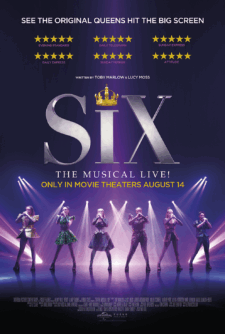
SIX: THE MUSICAL LIVE!
Six queens, zero regrets — a glitter-drenched pop concert that turns Henry VIII's wives into their own headline act.
Should You Watch It?
If you love a pop concert that resembles theater, this one delivers. The vocals sound powerful, the live band plays in sync, and the light show alone justifies the ticket price. You will walk out humming and probably leave believing the show's closing argument: these women deserve recognition beyond a king's marriage record.
However, you should know what you sign up for. The humor leans towards crude, the choreography remains provocative, and the show avoids shying away from sexual content, revealing costumes, or a running joke about beheading that some viewers find flippant given the real history behind it. If frank language and suggestive staging make you uncomfortable, you'll spend more time wincing than singing along.
If you seek an energy-filled night out with friends who don't mind sharp edges, you'll leave feeling fulfilled and likely still buzzing. Don't bring your child or teen hoping for a reverent history lesson; you will leave disappointed as this movie prioritizes entertainment over caution, and it makes no secret of that.
The Story
NO SPOILERS — WE KEEP THE SURPRISESSix women, one famous husband, and a microphone each. Henry VIII's wives take the stage not as history's footnotes but as pop stars. They turn their marriages into a full-blown competition: who suffers the most, who loves the hardest, who deserves top billing in a story that always tells about them instead of by them. As each queen steps up to claim her verse, the contest feels less like fun and more like someone proves something, or maybe disproves it. The crown turns out not to be the point at all.
Is It Any Good?
Yes and no. The vocal performances are genuinely excellent, each queen given a distinct musical style that showcases real range across the cast. The band is sharp, the pacing rarely sags, and the concert structure gives the vocal performances a chance to impress with genuine excellence, showcasing each queen's distinct musical style and real range across the cast. The band plays sharply, and the pacing maintains momentum, making the concert structure captivating even for those who usually avoid musicals.
The show earns real credit with its turn: what begins as a shallow contest over who suffered most transforms into thoughtful reflection, especially as the third and sixth wives lead the narrative away from spectacle. This craftsmanship, rather than accident, stands out. Therefore, the rating reflects the quality of a well-made, well-performed piece of musical theater. The caution revolves around content, as the language, staging, and sexual references appear frequently.
Feminism serves as the central theme, and the show clearly states this message. From the opening number's "Herstory" wordplay to the closing anthem celebrating women's unity beyond their husbands' shadows, each scene reinforces the idea that these women deserve recognition beyond their roles as wives. The intention remains earnest, and repetitions become obvious, culminating in a finale that delivers the message loudly and clearly, with a bullhorn instead of a whisper.
The Worldview
The show's core belief asserts that a woman's worth doesn't depend on a man's approval. This claim aligns with a biblical view of human dignity, as Scripture grounds worth in being made in God's image, not in male validation. The show diverges in its approach: it frames identity almost entirely as self-generated, often emphasizing "I don't need anyone" as the emotional peak of multiple songs, rather than acknowledging a Creator who defines people's worth first.
The production loosely borrows from scripture and faith, using imagery like a staged "confession" with crosses and references to God's will in Catherine Howard's excommunication, yet it fails to engage with the deeper teachings on repentance, marriage, or grace. The use of religious symbols aims for dramatic weight without theological depth.
The underlying ache remains real for these women, whose stories often fell into the hands of others, and whose worth was measured by fertility, favor, and survival. The show effectively names that grief, particularly through the songs of the third and sixth wives. Culturally, the production showcases diverse casting and targets a young audience beginning to explore feminism as a framework, which explains its energy and some blind spots. It celebrates resilience and voice, but it neglects to explore the true source of that worth beyond the self.
The Content Guide
The specifics — spoilers included by nature — so you can judge for your own family.
Dominant Worldview and Other Worldview Content/Elements
Strong Humanist worldview that exalts female self-determination and personal identity as sourced entirely in the self rather than in a Creator, with a heavy Feminist and political overlay woven through nearly every scene and song, culminating in a message that women's worth is defined by unity with one another rather than by any man; mixed with light Pagan/occult-adjacent elements, as the show borrows Christian imagery in a staged "confession" scene with crosses, references to God's will, and mentions of studying scripture — without any genuine engagement with biblical doctrine, using faith language purely for aesthetic or emotional effect; also contains Romantic elements, as several of the wives' arcs are driven by longing for love and validation before the show pivots away from that toward self-sufficiency
Foul Language
Five obscenities and profanities total, one crude phrase “load of BS", one use of "OMG” as an exclamatory obscenity
Violence
Light to moderate, mostly verbal/thematic rather than depicted with repeated, casual references to beheading, including the show's recurring mantra “Divorced, beheaded, died, divorced, beheaded, survived.”
Sex
Direct reference to not wanting to “bang” someone, a simulated sexual gesture, multiple lyrical discussions of wanting to have sex, adultery and polygyny referenced, provocative and sexually suggestive choreography throughout, and one staged scene where a wife's outer garments are stripped off in a moment meant to convey a sexual encounter
Nudity
No nudity, though one wife lifts her own breast twice as a comedic/sexual gesture, and one costume-removal scene is staged for sexual implication without actual nudity
Alcohol Use
Light — drinking is referenced in one song, without glamorization or rebuke emphasized
Smoking and/or Drug Use and Abuse
No smoking or drug use
Miscellaneous Immorality
A scene with a competitive comparison of women's bodies (breast and rear size), mockery and peer pressure among the wives, prideful boasting, moral relativism regarding sexual behavior, casual use of religious/spiritual language detached from genuine belief or reverence, and slander of one another.
Talk About It
Questions for the drive home, the dinner table, or the youth group.
The show argues that a woman's worth comes from within herself and from the support of other women. Where does the Bible say our worth actually comes from? How is being made in God's image different from being self-made? Genesis 1:27 Psalm 139:13-14
The Final Word
This is a well-crafted, well-sung show with a real ache at its center of women wanting to be seen as more than a footnote. But the language, sexual content, and provocative staging are frequent enough that this isn't a casual family outing. Go in with eyes open, enjoy the talent, but leave the little ones at home.