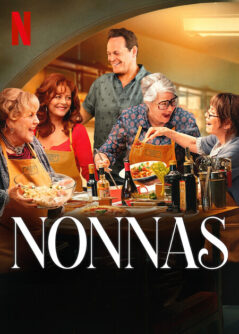
NONNAS
A love letter to family, food, and forgiveness — with a little caution for the kids.
Should You Watch It?
Here's the short version: this is a genuinely lovely movie, and most families will want to see it — with eyes open about a few specifics.
Nonnas tells the true-inspired story of a man who honors his late mother by opening an Italian restaurant staffed entirely by grandmothers. It's built on themes Scripture loves — grief carried in community, family stretching wider than blood, forgiveness practiced daily, prayer woven into ordinary life. The performances are excellent, the soundtrack is a joy, and the whole thing has real heart.
It also has real content. Ten obscenities, a handful of profanities, characters drinking throughout with one scene of drunkenness, some suggestive moments, and a former nun's storyline involving a same-sex relationship — handled with more sympathy than Scripture would extend, though she is shown returning to the church. None of it is graphic, but it adds up.
For adults and older kids: go enjoy it. For younger children: wait, and maybe watch it yourself first.
The Story
NO SPOILERS — WE KEEP THE SURPRISESJoe grew up in his mother and grandmother's Brooklyn kitchen, learning that food is how this family says "I love you." When his mother dies, Joe is unmoored — restless in his job, unsure what to do with the insurance money she left behind. His friends push him toward something bold: open a restaurant, and staff the kitchen with grandmothers, so that customers can taste the same love he grew up on. He places an ad, assembles his Nonnas, and the real work — and the real family — begins.
Is It Any Good?
Four stars is a strong endorsement, and here it's earned. The opening flashback in the family kitchen sets the tone beautifully — a movie that knows food is never just food. From there, the film rides on its cast: the performances are described as amazing, and the soundtrack does real work carrying the mood. This is craft in service of warmth, not spectacle — a small, well-made film that knows exactly what kind of story it's telling and tells it with care.
The Worldview
Underneath the pasta and Limoncello sits a genuinely strong, biblical moral core. Characters support one another through grief, pray with Scripture, and forgive each other — themes the film returns to again and again. It also carries a clear pro-capitalist thread: Joe builds something from nothing, takes a risk, and creates a community and a livelihood through honest work. The setting is thoroughly Catholic — a cross necklace, a statue of Mary, mentions of baptism, communion, and the rosary, a prayer to a saint that still closes "in the name of the Father, Son and Holy Ghost." Protestant viewers may notice the Catholic texture more than Catholic ones will.
The film is mitigated, though, by a few threads worth naming. There's a mild romantic strain where characters describe love and beauty as things you simply "feel in your gut" rather than choose or commit to. There's light feminist content about women refusing to feel invisible as they age. And there's a storyline where a former nun explains that she left the convent over a same-sex relationship the Church calls sin — the film treats her return to the Church warmly, but frames her original departure with more sympathy than conviction.
Even so, the film's deepest longing — people who've lost family finding a new one around a table — echoes something true. "God settles the solitary in a home" (Psalm 68:6). Nonnas gets the ache right, even where it softens the answer.
The Content Guide
The specifics — spoilers included by nature — so you can judge for your own family.
Content Summary
<span data-contrast="auto">(CC, BB, CapCapCap, PP, Ro, Fe, PC, Ab, Ho, LL, V, S, AA, MM): </span><b><span data-contrast="auto">
Dominant Worldview and Other Worldview Content/Elements
</span></b><span data-contrast="auto"> Strong Christian, biblical, moral worldview with very strong pro-capitalist content, and strong Pro-American elements, in a Roman Catholic context and setting, promotes family, community and friends supporting others through grief, with mentions of baptism, communion, miracles, a character wears a cross necklace, plus there’s a statue of Mary and mention of the rosary (which may turn off some Protestants), and a character prays to St. Pedro Pio but closes the prayer in the name of the Father, Son and Holy Ghost, mitigated by some Romantic elements where characters talk about having a feeling in their gut, loving their work and beauty being a feeling, light feminist content where women discuss not being invisible as they age and celebrating their beauty, and mitigated by some immoral and unbiblical politically correct or “woke” homosexual elements where a woman confesses she loved a woman and left the convent because the Catholic Church condemns it as a sin it she returns to the Church, and nun claims, “It’s not easy to live in a world who rejects who you are”; </span><b><span data-contrast="auto">
Foul Language
</span></b><span data-contrast="auto"> 10 obscenities (including four “d” words and six “h” words), one GD profanity, three light profanities, and some crude or rude comments; </span><b><span data-contrast="auto">
Violence
</span></b><span data-contrast="auto"> Light violence with an elderly woman throwing dried pasta at cook, a woman smacks her husband's hand when he reaches for food, two women spit at each other, two elderly people get into a food fight, and an elderly woman hits a man with her purse twice; </span><b><span data-contrast="auto">
Sex
</span></b><span data-contrast="auto"> No implied or depicted sex but some pro-homosexual content such as a woman mentions her lesbian love for a woman that forced her to quit her life as a Roman Catholic nun, a woman grabs another woman’s hand to touch her covered breast and grabs her own breast when discussing breast implants, people greet each other with kisses on the cheek, and an unmarried couple share a kiss; </span><b><span data-contrast="auto">
Nudity
</span></b><span data-contrast="auto"> No explicit nudity but female characters wear low-cut shirts that show cleavage, and one female character stirs food while the camera focuses on her breasts; </span><b><span data-contrast="auto">
Alcohol Use
</span></b><span data-contrast="auto"> Alcohol use prominent as characters often drink wine, toast with alcohol, and offer bottles of alcohol as gifts, a young boy’s hand reaches for a glass of red wine, but an adult’s hand smacks it away, elderly women drink shots of Limoncello, one character gets drunk and talks about not being hungover because she drank water, a character talks about sneaking out of prom to buy booze and pours liquor into a bowl of punch from a flask, a bar shows bottles of wine on the wall, and an elderly woman grabs a bottle while sipping red wine from a glass, and customers drink wine and liquor throughout; </span><b><span data-contrast="auto">
Smoking and/or Drug Use and Abuse
</span></b><span data-contrast="auto"> No smoking or drugs; and, </span><b><span data-contrast="auto">
Miscellaneous Immorality
</span></b><span data-contrast="auto"> A married couple bicker and call each other names, two elderly women argue but it’s lighthearted, co-workers mislead and lie to the manager to cover up for one character being late to work, a health inspector bribes people to pass inspection but is rebuked, one woman talks negatively about marriage, and a character admits to being estranged from her family but calls her daughter in the end.</span><span data-ccp-props="{}"> </span> <span data-ccp-props="{}"> </span>
Talk About It
Questions for the drive home, the dinner table, or the youth group.
The Nonnas find purpose by cooking for others after their own losses. How does Scripture describe carrying grief together, rather than alone?
Galatians 6:2 · Romans 12:15Joe builds a whole restaurant to honor his mother's memory. What does it look like to honor a parent even after they're gone?
Exodus 20:12 · Proverbs 31:28Several relationships in the film are repaired through forgiveness. What makes biblical forgiveness different from just "moving on"?
Ephesians 4:32 · Colossians 3:13One character leaves religious life over a same-sex relationship the Church calls sinful, then returns to the church. How should Christians hold both grace toward people and truth about sin at the same time?
John 8:1–11 · Romans 3:23–24The Final Word
Nonnas is a genuinely warm film about grief, family, and the table that holds them together — well-made, well-acted, and mostly aligned with what matters most. It's also got language, drinking, and a storyline your family should talk through, not just watch. Our answer stands: worth the trip — older kids and adults. Choosing for younger children this week? See our latest.