THE PERSIAN VERSION
Her Version of Perversion
What You Need To Know
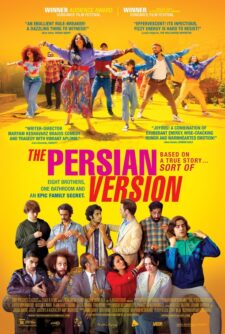
THE PERSIAN VERSION is a comedy drama about a young Iranian-American woman, Leila, now living in Brooklyn, New York. Leila travels to New Jersey where her family has gathered at a hospital. There, her father prepares for a risky open heart surgery, and the family begins to catch up with one another. Leila has clashed with her more traditional Muslim mother, Shireen, for many years, specifically in regards to Leila’s lascivious tendencies, lesbian proclivities and postmodern lifestyle. So, she rejoins her family reluctantly, choosing to stay with her grandmother, who also seems to be an outsider of sorts.
Describing herself as “an outcast” who’s “too Iranian for America and too American for Iran,” Leila breaks with the religious, social norms of previous generations. She sees this encapsulated in her mother’s silence and “judgmental” statements. However, Leila is shocked to hear that the story of why her parents first brought their family to the United States is not what she’s been told. Her grandmother, in whom she confides, tells her that her parents’ move to America had to do with a scandal revolving around her mother.
As the plot unfolds and multiple family secrets are revealed, Leila begins to see that she and her mother are not as different from each other as she thought. Can Leila connect with her parent in a way she never thought possible? And, can her mother come to see that their paths, though qualitatively different, have in common the aim of individual rebellion against society?
There are some compelling themes in this cross-cultural, multi-generational drama. The breaking of the Fourth Wall so that two major characters can uniquely tell their stories directly to the camera is effective. It strengthens the movie’s storytelling and character development. The action is overall quite good, with the actresses playing the mother and daughter at the heart of the tale giving standout
performances. The movie’s cross-cultural elements are also believable and impactful. However, the resulting takeaway of the protagonist that one can’t put their faith in anything beyond themselves is a philosophical conclusion of 21st Century Romantic postmodernism that has frankly become a cliché. To quote the protagonist, “The only way to survive was to not put my faith in any of the rules: not science; not politics.”
Using flashbacks to tell its story of mother-daughter conflicts, THE PERSIAN VERSION is more successful as a drama than a comedy. Despite the father’s impending heart transplant being the impetus for the family gathering, the real drama is the strained relationship between mother and daughter. Leila’s mother opposes her sexual depravity, lascivious lifestyle and her long-established determination to break all the rules. Meanwhile, Leila sees her mother as alternately heartless and enigmatic. For example, when Leila shows up at a holiday gathering with her lesbian lover, her mother asks them to leave, but it’s clear that she desires to be with her daughter and is heartbroken at having to send her away. Leila angrily says to her mother, in a fit of postmodern rage, “You cannot accept my truth” about her sexuality, and storms off. It will take the revelation of her mother’s own difficult and complex past for Leila to see how it’s impossible for her mother to react to her in any other way. Finally, the resolution of the conflict in the movie is no resolution at all. For example, there’s the sense of a “live and let live” unspoken agreement at the end, but that is far from a meaningful sowing up of this ultimately tragic tale.
THE PERSIAN VERSIAN has a strong Romantic, politically correct, postmodern, pro-homosexual worldview. The daughter and, ultimately, the whole movie, try to validate “my truth” as opposed to “the truth,” where characters rage against traditional moral, religious, Muslim, social norms. The movie’s few instances of moral decision making are not enough to redeem this woke film. For example, the protagonist decides not to abort her child, which is very good. However, she becomes pregnant with this precious little one due to her depraved one-night stand with an actor still dressed in his drag costume at a Halloween party. Also, when one considers the depraved minds of the parents who will be raising this child, the bright light of saving one child is severely darkened. Obviously, it’s a positive biblical, moral choice not to abort one’s child, but the movie provides viewers no evidence that parents will guide their child toward anything solid in promoting life or ultimate happiness in their Creator.
THE PERSIAN VERSION also has brief but strong foul language, and strong sexual content and references throughout. The story’s basic philosophical assumption that there’s no such thing as “the truth,” only “my truth,” is an example of what MOVIEGUIDE® likes to call “intellectual relativism.” This leaves the worldview in the dark realm of Romantic postmodernism, where any form of immorality or even depravity is condoned because truth is ultimately relative.
THE PERSIAN VERSION is an unacceptable movie entertainment due to its overt cheerleading of a woke agenda throughout its running time. Discerning, media-wise adult moviegoers will want to skip this R-rated dramedy.
The Content Guide
The specifics — spoilers included by nature — so you can judge for your own family.
Dominant Worldview and Other Worldview Content/Elements
Very strong Romantic, postmodern, politically correct, “woke” worldview with very strong pro-homosexual elements and where characters try to validate “my truth” in opposition to “the truth” and rage traditional religious, Muslim, social mores, and there are a few instances of moral decision making, but they’re not enough to redeem this politically correct, woke movie, plus there are some feminist elements in the story with women having careers, by choice and by circumstances
Foul Language
11 “f” words, two other obscenities, and one strong GD profanity
Violence
Two birth scenes (one where a stillbirth is shown) display women screaming in pain and much blood on sheets and a table
Sex
Woman fornicates with a man dressed in drag at a Halloween party (she takes off her bra, pushes him down on the bed, straddles him in her pink bikini, breaks the fourth wall, and the scene ends); the woman later pushes a man’s legs off of her after they have just had sex and begins to put her bikini back on (legs exposed and upper male nudity); it is later revealed that she is pregnant, and the drag queen is the father, woman meets her former lesbian lover in a grocery story and tries unsuccessfully to avoid the awkward conversation that follows, the protagonist’s homosexual tendency is an integral part of the plot, much sexual dialogue and many sexual references throughout movie, grandmother gives her granddaughter suggestions on how to be sexually active and avoid pregnancy
Nudity
A woman in a burka and a pink bikini exposes her legs, midriff, and more on the streets and at a Halloween party, and a woman’s legs are exposed as she gives birth in a hospital
Alcohol Use
Social drinking throughout movie
Smoking and/or Drug Use and Abuse
Occasional smoking, and a man on life support waiting for a heart transplant is told that this situation should make him stop smoking, but no drugs;
Miscellaneous Immorality
Dysfunctional mother-daughter relationship where more traditional Muslim mother frowns on her daughter’s lesbian, libertine lifestyle.