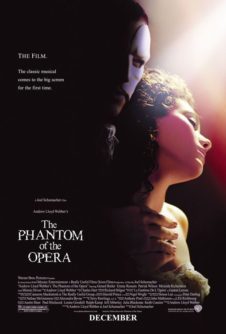
THE PHANTOM OF THE OPERA
Sumptuous Christian allegory sings grace, sacrifice, and redemption.
Should You Watch It?
This is a four-star movie for viewers who enjoy musical theater. It is sumptuous, visually bold, and filled with gorgeous, haunting melodies. The spectacle, acting, singing, dramatic motifs, and music come together beautifully, especially in the inspirational ending.
The film also preserves and expands the Christian allegory of the original musical. Its deepest movement is toward grace, sacrifice, forgiveness, and redemption. That gives the melodrama more substance than its heightened style may initially suggest.
The content calls for discernment rather than a blanket family recommendation. Younger children may be frightened by some images and sounds, while older children from media-wise families should be fine. For teenagers, adults, and families comfortable with the listed concerns, this is worth seeing.
The Story
NO SPOILERS — WE KEEP THE SURPRISESBeneath a Paris opera house lives a disfigured, angry man known as the Phantom. He terrorizes the cast and crew so that Christine, a young woman he has taught, can sing the lead role.
When Christine’s singing brings the attention of Raoul, the opera’s new patron and a rich young nobleman, the Phantom’s love for her turns jealous. As Christine and Raoul grow closer, the Phantom’s attacks become bolder, and Christine must decide whom she can trust.
Is It Any Good?
Four stars means this is an exceptionally successful adaptation. The late-nineteenth-century sets and costumes are spectacular, the visuals succeed boldly, and the famous music remains beautiful and inspirational.
The performers act and sing excellently, with Emmy Rossum standing out as Christine. They may not equal the original English Broadway cast, and some viewers may find the cast too young or inexperienced, but the work retains the source material’s bravado, depth, spectacle, and gorgeous musical motifs.
Andrew Lloyd Webber’s dialogue and music are expertly woven together from beginning to end. Joel Schumacher adds visual motifs of his own, and the dramatic, visual, and musical elements come together powerfully in the climax.
The Worldview
The film presents a strong Christian allegory about grace, sacrifice, forgiveness, and redemption. Christine becomes a symbolic Christian character whose compassion, sympathy, kindness, and willingness to sacrifice herself confront the Phantom’s inner evil. Her undeserved love leads him to relent, suggesting that grace can end the darkness within a person.
The movie also adds positive Christian imagery. Christine seeks refuge in the opera house chapel, where a stained-glass window appears to show a monk holding a cross while preaching the Gospel of Christ. Images of a rose and snow suggest the flesh and blood of Christ and become symbols of the Phantom’s redemption. At the story’s climax, Christine makes an important plea to God, though the moral meaning is not perfectly stated because of possible romantic and antinomian elements.
The film’s central longing is for redemption through undeserved love. Scripture says, “For by grace you have been saved through faith” (Ephesians 2:8).
The Content Guide
The specifics — spoilers included by nature — so you can judge for your own family.
Content Summary
Very strong Christian allegory and worldview about grace, sacrifice, forgiveness, and redemption, which includes heroine making an important plea to God at the story’s climax, with strong moral tone implied, though not perfectly stated because of some possible Romantic, antinomian elements; two light obscenities and two light profanities; boy in circus whipped, boy strangles and murders his cruel attendant, men hanged, people crushed by falling chandelier but little is shown, and a swordfight with hero getting his arm wounded; villain caresses and seduces heroine but no sex scenes implied or depicted; man moons the camera and some skimpy dancer outfits, plus one of the opera players looks through a secret peephole into the female dressing room but no nudity is shown; alcohol; cigar smoking; and, seductive villain tries to seduce heroine, villain seeks revenge and abduction. GENRE: Musical Melodrama
Talk About It
Questions for the drive home, the dinner table, or the youth group.
Christine responds to the Phantom with compassion and sacrifice. How are grace and forgiveness different from approving someone’s wrongdoing?
Ephesians 2:8–9 · Colossians 3:13The Phantom’s anger and desire for revenge shape his choices. What does Scripture teach about giving vengeance to God?
Romans 12:19 · Proverbs 20:22Christine seeks refuge in a chapel. Where do you turn when fear or confusion makes it hard to know whom to trust?
Psalm 46:1–2 · Proverbs 3:5–6The story presents redemption as a turning away from evil. What does genuine repentance look like in a person’s life?
2 Corinthians 7:10 · Acts 3:19The Final Word
This is sumptuous, melodic filmmaking with real dramatic depth and a redemptive Christian heart. Its brief violence and other concerns call for discernment, especially with younger children, but teenagers and adults who appreciate musical theater should find much to admire. WORTH THE TRIP — TEENS AND ADULTS