TWILIGHT OF THE COCKROACHES
An inventive but troubling allegory best saved for home viewing.
Should You Watch It?
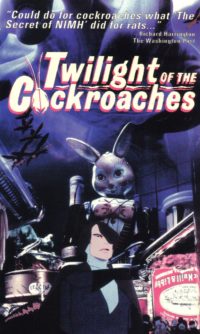
TWILIGHT OF THE COCKROACHES is an unusual Japanese animated film that can be taken as a simple adventure or a complicated social allegory. Its clever blend of live action and animation gives viewers a roach-eye view of an apartment, turning ordinary household clutter into a strange, glittering world.
The film’s ideas are more troubling than its craft is satisfying. It explores militarism, purity of the species, survival of the fittest, genetic adaptation, cultural accommodation, social conformity, moral repression, and the generation gap. Those themes give the fable weight, but the Fascist humanistic outlook makes the experience difficult to embrace.
The content rating calls for discernment, while the two-star quality rating makes this better suited to home viewing than a family outing. Watch it at home if its allegorical questions genuinely interest you.
The Story
NO SPOILERS — WE KEEP THE SURPRISESIn bachelor Saito’s apartment, a colony of cockroaches enjoys food left on unwashed dishes and the dregs remaining in wine bottles. Their hidden world changes when Saito’s girlfriend arrives, bringing conflict between the humans and the roaches.
The story follows this struggle from the cockroaches’ ground-level perspective, presenting their domestic life as both an adventure and a larger fable about society.
Is It Any Good?
Two stars means this film has clever ideas and memorable craft choices, but its strengths do not fully overcome its limitations. The combination of live action and animation is inventive, and the director maintains the roaches’ physical point of view from the ground level up.
A messy kitchen table crowded with bottles, cans, and boxes becomes, from the roaches’ perspective, like Las Vegas—all glitz and free choice. The film is also provocative as a fable. Still, the complex social allegory and troubling ideas make it an uneven experience rather than a fully satisfying one.
The Worldview
The director has said that the film is about Japan, connecting the concept of a “hated” species with the racial and cultural enmity with which Japan is perceived. That idea gives the story another dimension, but it also becomes troubling because the film engages with Fascist concepts of militarism, purity of the species, survival of the fittest, genetic adaptation, cultural accommodation, social conformity, moral repression, and the generation gap.
The film presents humans and cockroaches through a social allegory rather than a straightforward moral framework. Its humanistic outlook is not grounded in biblical ideas about the equal value of people before God. Instead, it raises questions about hated groups, conformity, adaptation, and the pressure to survive without clearly resolving them in a biblical direction.
The film’s central concern with social hostility and the treatment of a despised group can prompt a more searching question about how we think and live: “Do not be conformed to this world, but be transformed by the renewal of your mind” (Romans 12:2).
The Content Guide
The specifics — spoilers included by nature — so you can judge for your own family.
Content Summary
A Fascist humanistic worldview complete with a couple of obscenities, slight sexual innuendo and violence.
Talk About It
Questions for the drive home, the dinner table, or the youth group.
The film presents a “hated” species and connects that idea with racial and cultural enmity. How does Scripture call us to treat people who are despised or excluded?
James 2:1–4 · Galatians 3:28The story raises questions about survival of the fittest and purity of the species. What does the Bible say about the value and dignity God gives His creation?
Genesis 1:26–27 · Psalm 8:3–6The film explores social conformity and moral repression. When should Christians resist the pressures of the culture around them?
Romans 12:2 · Acts 5:29The director uses the roaches’ viewpoint to make an ordinary apartment look entirely different. How can changing our perspective expose assumptions we have taken for granted?
Philippians 2:3–4 · Proverbs 18:13The Final Word
TWILIGHT OF THE COCKROACHES offers inventive animation and serious questions, but its two-star execution and troubling worldview make it a poor family outing. Teenagers and adults who are curious about its allegory can consider it at home, with discernment. The practical answer is WAIT FOR HOME.